
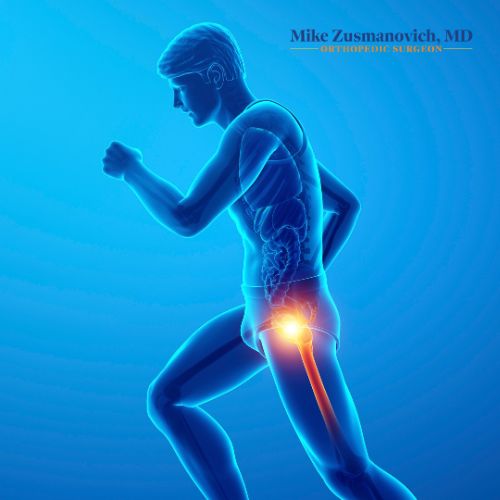
You stand up after a long drive and your hip clicks. You pivot on the soccer field, and something catches deep in your groin. You bend to tie your shoe and feel a pinch that stops you mid-motion.
If any of that sounds familiar, it describes one of the most common presentations of hip pain in younger, active patients: a tear of the acetabular labrum.
It is also one of the most commonly missed. Hip labral tears get attributed to a groin pull that never quite heals, or a tight hip flexor, or simply getting older. Patients often spend months — sometimes years — stretching something that stretching will not fix.
Here is what is actually happening, and what the treatment path looks like.
What the Labrum Does, and Why a Tear Makes Noise
The hip is a ball-and-socket joint. The labrum is a ring of tough fibrocartilage that runs around the rim of the socket, and it does three important jobs:
- Deepens the socket, adding stability to the joint
- Creates a suction seal that keeps a thin layer of joint fluid pressurized between the ball and socket
- Distributes load across the cartilage surface so no single area takes too much
When the labrum tears, the free edge of that tissue can become an unstable flap. As the hip moves through certain positions, the flap gets caught between the ball and the socket — and then releases.
That is the click. That is the catch.
The mechanical sensation is not imagined, and it is not the joint “cracking” the way knuckles do. It is tissue getting trapped where it should not be. The loss of the suction seal also changes how fluid pressure and load are distributed inside the joint, which is why a labral tear can ache even at rest.
Symptoms that Point Toward a Labral Tear
Not every hip that clicks has a torn labrum. But this constellation of symptoms is characteristic:
- Deep groin pain. Usually felt in the front of the hip or deep in the groin rather than on the outside. Many patients instinctively cup a hand over the side of the hip in a C shape when asked to point to the pain — clinicians call this the C-sign.
- Mechanical symptoms. Clicking, catching, popping, or a sensation of the joint briefly locking.
- Pain that is positional, not constant. Prolonged sitting. Getting out of a low car seat. Putting on socks and shoes. Deep squats. Pivoting or cutting.
- Stiffness and lost rotation. Particularly a loss of internal rotation compared with the other side.
- A feeling of instability. Some patients describe the hip as unreliable, as though it may give way, especially during rotation under load.
What labral tears usually do not cause: pain that is worse at rest than with activity, pain that wakes you at night, or an inability to bear weight. Those warrant prompt evaluation for other causes.
Why the Labrum Tore in the First Place
This is the part that matters most for treatment, and the part most often skipped.
A labrum in a normally shaped, uninjured hip does not usually tear on its own. In the majority of young, active patients, the tear is a consequence of something else:
- Femoroacetabular impingement (FAI). This is the most common underlying cause. Subtle differences in bone shape — extra bone at the femoral head-neck junction (cam morphology), a socket that covers the ball too far (pincer morphology), or both — cause the bone to pinch the labrum repeatedly during hip flexion and rotation. Over thousands of cycles, the labrum fails.
- Trauma. A hip dislocation, a fall, a motor vehicle accident, or a direct collision.
- Repetitive high-demand motion. Hockey, soccer, lacrosse, golf, dance, martial arts, and distance running all load the hip in flexion and rotation. Dr. Zusmanovich treated athletes across these sports during his sports medicine fellowship at the Cedars-Sinai Kerlan-Jobe Institute, and the pattern is consistent.
- Hip dysplasia. The opposite of pincer FAI — a socket that is too shallow, leaving the labrum to absorb load it was never designed to carry.
- Degenerative change. In older patients, labral tearing can be part of early osteoarthritis rather than an isolated injury.
Why does this distinction matter? Because repairing a labrum without addressing the bone shape that tore it is how surgery fails. If cam impingement caused the tear, the cam has to be addressed in the same operation — otherwise the repair is loaded by the same abnormal mechanics that broke it the first time.
One Honest Caveat About MRI Findings
Labral tears show up on hip MRIs in a meaningful number of people who have no hip pain at all. The imaging finding alone is not the diagnosis.
This is worth emphasizing, because patients sometimes arrive with an MRI report reading “labral tear” and understandably assume surgery is the next step. It is not automatic. The diagnosis is made by putting the imaging together with a patient’s history and a careful physical examination — and confirming that the labrum is genuinely the source of the symptoms.
How a Labral Tear Gets Diagnosed Properly
History and physical examination. Specific provocative tests — the FADIR test (flexion, adduction, internal rotation) and the FABER test — reproduce impingement-type pain and help localize the problem to inside the joint.
X-rays first. Before any advanced imaging, plain films reveal bone shape, whether cam or pincer morphology is present, how much cartilage space remains, and whether arthritis is a factor. This step gets skipped surprisingly often, and it is the one that determines whether arthroscopy is even appropriate.
MRI, ideally an MR arthrogram. Contrast injected into the joint dramatically improves visualization of the labrum.
Diagnostic injection. When the picture is unclear, numbing medication placed inside the hip joint is a useful tiebreaker. If pain substantially improves for a few hours, the problem is inside the joint. If nothing changes, the search moves elsewhere — the hip refers pain from the spine, the SI joint, the abdominal wall, and the hip flexors, and all of those can mimic a labral tear.
Treatment: Starting With What Does Not Involve Surgery
Most patients with a hip labral tear begin with non-surgical management, and a meaningful number never need an operation.
Activity modification. Temporarily reducing the specific positions that pinch — deep flexion, deep squats, aggressive pivoting.
Targeted physical therapy. This is the centerpiece, and targeted is the operative word. Effective hip therapy emphasizes gluteal and core strength, hip abductor control, correcting pelvic position, and motor control through the mid-range. What it deliberately avoids is aggressive hip flexor stretching and repeated end-range hip flexion — the exact positions that irritate an impinging labrum. Many patients report that therapy made them worse, and when the program is reviewed, this is usually why.
Anti-inflammatory medication, where clinically appropriate.
Intra-articular corticosteroid injection. Both diagnostic and therapeutic, and in some patients it provides durable relief.
A reasonable trial is generally 8 to 12 weeks of structured, well-directed therapy. That is long enough to know whether the hip will settle down.
When Hip Arthroscopy Makes Sense
If a well-executed course of conservative care has not worked and the mechanical symptoms persist, arthroscopic surgery becomes a reasonable conversation.
Hip arthroscopy is performed through two or three small portals with a camera, on an outpatient basis. Depending on what is found, the procedure may include:
- Labral repair. Reattaching the torn labrum to the socket rim with small suture anchors. This is preferred whenever tissue quality allows, because preserving the labrum preserves the suction seal.
- Labral debridement. Trimming an unstable flap when the tissue is not repairable.
- Labral reconstruction. Rebuilding a deficient labrum with a graft, in cases where too little healthy tissue remains.
- Osteoplasty. Reshaping the cam bump on the femur, or trimming an over-covering acetabular rim, to eliminate the impingement that caused the tear. As noted above, this is often the difference between a repair that lasts and one that does not.
- Capsular closure. Repairing the joint capsule to maintain stability.
Recovery, Realistically
- Crutches for roughly one to three weeks
- Physical therapy beginning within days of surgery
- Return to running around three to four months.
- Return to cutting and pivoting sports typically four to six months, sometimes longer.
- Continued improvement for up to a year
Seeing a Hip Specialist in Patchogue
Hip labral tears reward early, accurate diagnosis. The longer an impinging hip grinds against an unstable labral flap, the more cartilage damage tends to accumulate — and cartilage is far less forgiving than labrum.
If your hip clicks, catches, or aches deep in the groin after sitting or activity, it is worth having it evaluated properly rather than stretching it for another six months.
Dr. Zusmanovich is a hip specialist in Patchogue who sees patients at 55 Medford Avenue, Suite E, as well as at three additional Suffolk County offices in West Babylon, Commack, and East Setauket. Every patient is evaluated and treated by Dr. Zusmanovich directly — the same physician who makes the diagnosis, performs any procedure, and follows the recovery through return to activity.


No comment