
If your teenage athlete has been complaining about lingering hip pain, it can be tempting to chalk it up to a routine muscle strain — especially if they’re active in soccer, hockey, lacrosse, dance, gymnastics, or any sport that involves repeated cutting, pivoting, or sprinting. Rest, ice, and a few days off usually take care of an everyday strain.
But what if the pain doesn’t go away? What if it keeps coming back every season? What if your child says it “clicks” or “catches” when they move a certain way?
For many young athletes, persistent hip pain isn’t just a strain. It can be a sign of underlying structural conditions that are commonly missed in busy primary care visits — and that, left untreated, can sideline a young athlete for months or even cause long-term joint damage.
For parents of teenage athletes across Long Island, understanding what to look for and when to seek expert evaluation from a hip specialist in Suffolk County can make all the difference in their child’s recovery and long-term joint health.

Why Hip Pain in Young Athletes Gets Misdiagnosed
The hip joint is a complex structure surrounded by powerful muscle groups, dense ligaments, and major nerves. When a young athlete complains of hip pain, the symptoms can mimic groin strains, hamstring pulls, lower back issues, or even abdominal problems.
That’s part of why these injuries get missed. A pediatrician or family doctor seeing a 15-year-old soccer player with vague “hip pain” will often prescribe rest, anti-inflammatories, and physical therapy. For a true muscle strain, that approach works. But for a structural condition inside the hip joint, those treatments don’t address the root cause, and the pain comes back.
The result is a frustrating cycle: rest, partial recovery, return to play, pain returns, repeat. Months can pass before the actual diagnosis is made. By that point, the athlete may have lost a season — and, in some cases, the underlying issue may have progressed.
Here are the three most common structural hip conditions in young athletes that are misdiagnosed or missed altogether.
1. Femoroacetabular Impingement (FAI)
Femoroacetabular impingement, usually called FAI, is one of the most common causes of persistent hip pain in young athletes, and it’s still significantly under-recognized at the primary care level.
FAI happens when there’s an abnormal shape or contact between the ball (femoral head) and the socket (acetabulum) of the hip joint. There are three main types:
- Cam impingement — the femoral head isn’t perfectly round, creating a bump that grinds against the socket
- Pincer impingement — extra bone growth on the socket rim that pinches the femoral neck
- Combined impingement — both cam and pincer features together
This abnormal contact can damage the cartilage and labrum of the hip whenever the athlete moves through certain ranges of motion, such as squatting, pivoting, deep hip flexion, or rotation. The activities that most demand of a young athlete’s hips are often the very motions that aggravate FAI.
Signs a teen may have FAI:
- Groin pain, especially after activity
- Pain when sitting for long periods (long car rides, classroom days)
- A “C-sign” — the athlete cups their hand around the side of the hip, with the thumb on the back and fingers on the groin, to point out the pain
- Stiffness or reduced range of motion compared to the other hip
- Pain when getting in and out of a car, or putting on shoes
FAI is most often diagnosed in athletes between ages 14 and 25, and it’s increasingly common in young people whose hips are still developing while they’re playing year-round, single-sport schedules. Catching it early matters — untreated FAI can lead to labral tears, cartilage damage, and early-onset hip arthritis.
2. Hip Labral Tears
The labrum is a ring of cartilage that surrounds the hip socket. It deepens the joint, provides stability, and creates a suction-seal effect that helps the hip move smoothly.
In young athletes, labral tears often develop secondary to FAI — the abnormal joint contact gradually wears down or pinches the labrum until it tears. But labral tears can also happen from a sudden trauma, like a fall onto the hip, a sudden twist during a tackle, or a forceful kick.
Signs of a labral tear:
- A clicking, catching, or locking sensation in the hip during movement
- Sharp pain in the groin or front of the hip with twisting motions
- Pain that worsens with prolonged sitting or activity
- A feeling of the hip “giving way” or being unstable
- Stiffness that doesn’t fully respond to rest or stretching
Labral tears are particularly easy to miss because they often don’t show up clearly on standard X-rays. A specialist evaluation, often including a contrast-enhanced MRI (called an MR arthrogram), is usually needed to confirm the diagnosis.
When labral tears go undiagnosed in young athletes, the joint instability can cause further cartilage damage and long-term wear. The good news: many labral tears can be successfully treated with arthroscopic surgery, especially when caught early. Athletes typically return to full activity within 4–6 months.
3. Stress Injuries (Including Femoral Neck Stress Fractures)
The most dangerous and most commonly missed category of hip injury in young athletes is the stress injury — a spectrum that ranges from early bone stress reactions to full stress fractures.
These injuries develop when repetitive impact loading (such as long-distance running, jumping, or constant cutting) outpaces the body’s ability to repair bone. The femoral neck, the narrow segment of bone connecting the ball of the hip to the rest of the femur, is particularly vulnerable.
Femoral neck stress fractures in young athletes are a medical urgency. If undiagnosed and the athlete continues to train, the bone can progress from a stress reaction to a true fracture, and in worst-case scenarios, the fracture can displace, requiring major surgery and threatening the long-term blood supply to the hip joint.
Signs of a hip stress injury:
- Deep, vague pain in the groin or front of the hip that worsens with activity
- Pain that started gradually, without a single injury event
- Pain at night, or pain that wakes the athlete up
- Pain when hopping on one leg
- Decreased athletic performance, increased fatigue
- A change in gait — sometimes subtle, sometimes a noticeable limp
Stress injuries are particularly common in distance runners, dancers, gymnasts, and athletes in high-volume training programs. They’re also more common in young female athletes, especially those with disordered eating, irregular menstrual cycles, or low bone density, a constellation known as the female athlete triad (now often called Relative Energy Deficiency in Sport, or RED-S).
If a young athlete has hip or groin pain that’s been steadily worsening over weeks rather than appearing suddenly, do not let them “push through it.” Get them evaluated promptly. Early diagnosis with a bone scan or MRI can mean treatment with relative rest. Late diagnosis can mean surgery.
When to See a Hip Specialist
Most muscle strains in young athletes resolve within 1–2 weeks with rest, ice, gentle stretching, and a gradual return to activity. If a teen’s hip pain doesn’t follow that pattern, that’s the signal it may be something more.
Specifically, parents should schedule an evaluation with a hip specialist if their athlete has:
- Hip or groin pain lasting longer than 2 weeks despite rest.
- Pain that returns every time they return to sport.
- Clicking, catching, or locking sensations in the hip.
- A noticeable limp or change in gait.
- Pain at night or pain that wakes them up.
- Sharp pain with specific movements (squatting, twisting, pivoting).
- A “C-sign” hand position when pointing out where it hurts.
- Reduced range of motion compared to the other hip.
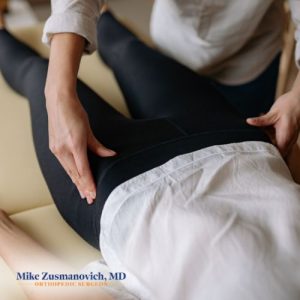
A specialist evaluation typically includes a detailed sports history, a focused physical exam with specific hip impingement tests, X-rays, and — when needed — an MRI to assess the cartilage, labrum, and bone health.
Why Early Evaluation Matters
Young athletes are growing, training hard, and often pushing through pain because they don’t want to lose their spot on the team. Parents are often the first to recognize that something more serious is going on.
The reality is this: structural hip conditions like FAI, labral tears, and stress injuries don’t get better on their own. They can get worse, sometimes silently, and damage the joint in ways that are much harder to address later. Catching these conditions in the teenage years means more treatment options, better outcomes, and the best chance of preserving an athlete’s hip for decades to come.
The other side of this is just as important: not every case of persistent hip pain is serious. Many young athletes simply have tight hip flexors, weak glutes, or training imbalances that respond beautifully to a focused rehab program. A specialist evaluation can definitively tell parents which path their athlete is on and, either way, put the family back in control.
Schedule a Consultation with a Hip Specialist in Suffolk County
If your teenage athlete is dealing with hip pain that just won’t go away, don’t wait through another season hoping it resolves on its own. Dr. Zusmanovich is a fellowship-trained hip specialist in Suffolk County who works with young athletes across Long Island, providing clear diagnoses, honest answers, and treatment plans tailored to each athlete’s goals, whether that’s returning to varsity competition, pursuing a college scholarship, or simply moving without pain.
Contact Dr. Zusmanovich’s office today to schedule a consultation. Your athlete’s long-term hip health is too important to leave to guesswork.