
Meniscus Tear vs. ACL Tear: How Do You Know Which One You Have?
Knee injuries are among the most common reasons people search online before ever calling a doctor. And if you’ve recently hurt your knee, whether during a sport, a misstep, or an awkward landing, there’s a good chance you’re trying to figure out whether it’s your meniscus, your ACL, or something else entirely.
The confusion is understandable. Both injuries can happen during similar activities, both cause knee pain, and both can leave you wondering whether you need surgery. But they are very different injuries that affect different structures, feel different, and are treated differently. Here’s what you need to know.
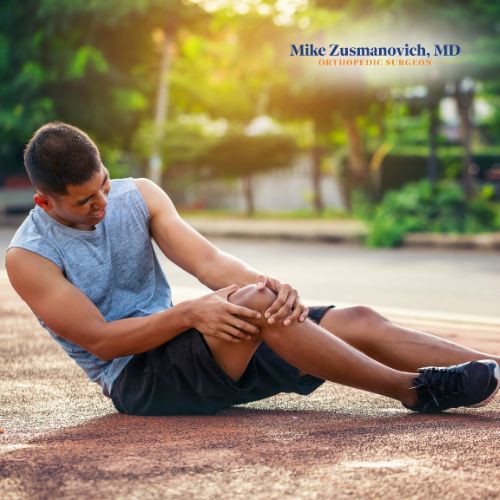
Knee Injury Treatment
Expert knee specialist in East Setauket. Dr. Mikhail Zusmanovich provides advanced treatment for meniscus tears and ACL injuries, offering both non-surgical and surgical solutions tailored to each patient’s needs.
What Are These Structures and What Do They Do?
Before diving into symptoms, it helps to understand what each structure actually is.
The ACL (Anterior Cruciate Ligament) is one of the four major ligaments that stabilize the knee joint. It runs diagonally through the center of the knee and primarily controls rotational movement and prevents the tibia from sliding forward relative to the femur. The ACL is critical for sudden changes of direction, pivoting, and decelerating, which is why it’s so commonly injured in sports like soccer, basketball, and skiing.
The Meniscus refers to two C-shaped pieces of cartilage, the medial meniscus on the inner side and the lateral meniscus on the outer side, that sit between the thigh bone and shin bone. They act as shock absorbers, distribute load across the knee joint, and help with stability. Meniscus tears can happen suddenly from a twisting injury or gradually over time from wear and degeneration.
How Each Injury Tends to Feel
While only a proper evaluation and imaging can confirm a diagnosis, the way these injuries present often differs in ways that can help point you in the right direction.
ACL Tear: What It Typically Feels Like
- A loud pop at the moment of injury — Many patients describe hearing or feeling a distinct “pop” when the ACL tears. This is one of the most recognizable hallmarks of an ACL injury.
- Immediate swelling — The knee typically swells significantly within the first few hours after an ACL tear due to bleeding inside the joint (hemarthrosis).
- Instability — A sense that the knee is “giving way,” buckling, or feels untrustworthy when you try to put weight on it. This instability is often the most disabling symptom.
- Pain with weight-bearing — Many patients find it difficult or impossible to walk normally immediately after an ACL tear.
- The injury often happens without contact — ACL tears frequently occur during non-contact movements like planting and pivoting, landing from a jump, or sudden deceleration.

Meniscus Tear: What It Typically Feels Like
- Pain along the joint line — Meniscus tears often cause tenderness specifically along the inner or outer edge of the knee, where the meniscus sits. This is one of the most telling signs during a physical exam.
- Swelling that develops more gradually — Unlike an ACL tear, swelling from a meniscus injury may build over 24–48 hours rather than appearing immediately.
- Locking or catching — Some patients with meniscus tears experience a mechanical sensation where the knee locks up, catches, or clicks with movement. This can indicate that a torn cartilage fragment is interfering with normal joint mechanics.
- Pain with deep bending or squatting — Activities that compress the knee joint, like squatting, kneeling, or climbing stairs, often aggravate meniscus pain.
- The ability to walk, but with discomfort — Unlike a complete ACL tear, many meniscus injuries allow patients to continue bearing weight and walking, though with pain and stiffness.
Can You Have Both at the Same Time?
Yes, and it’s more common than many people realize. Certain high-impact injuries, particularly twisting mechanisms with the foot planted, can damage both the ACL and the meniscus simultaneously. This is sometimes referred to as a combined injury, and it requires careful evaluation to identify all involved structures before determining a treatment plan. If you had a significant knee injury and are experiencing both instability and joint-line pain, it is especially important to be seen promptly.
Key Differences at a Glance
|
ACL Tear
|
Meniscus Tear
|
|
|
Classic symptom
|
Pop + instability | Joint-line pain + catching/locking |
|
Swelling
|
Immediate and significant | Gradual, may be mild to moderate |
|
Weight-bearing
|
Often very difficult | Often possible but painful |
|
Mechanism
|
Pivoting, landing, deceleration | Twisting, squatting, degeneration |
|
Instability
|
Common and significant | Less common |
|
Age group
|
Often younger, active patients | Any age; degenerative tears common in 40s+ |
Why You Can’t Self-Diagnose — And Why It Matters
Here’s the honest truth: even experienced orthopedic surgeons don’t diagnose these injuries solely based on symptoms. A physical examination and an MRI are typically needed to confirm the diagnosis, identify the exact location and severity of the tear, and determine whether other structures are involved.
Getting the diagnosis right matters because the treatment paths are very different. A complete ACL tear in an active patient almost always requires surgical reconstruction to restore stability. A meniscus tear, depending on its size, location, and the patient’s age and activity level, may be treated conservatively with physical therapy or may require arthroscopic surgery to repair or trim the damaged tissue.
Treating the wrong injury or missing a combined injury leads to prolonged pain, ongoing instability, and potentially greater joint damage over time.
When to See a Knee Specialist
You should seek evaluation promptly if you experience any of the following after a knee injury:
- A pop followed by immediate swelling and instability
- Inability or significant difficulty bearing weight
- A knee that locks, catches, or gives way
- Persistent pain that doesn’t improve within a few days
- Swelling that develops within hours of an injury
Early evaluation not only leads to a more accurate diagnosis, but it also allows treatment to begin sooner, which often improves outcomes, particularly for ACL injuries, where early physical therapy and planning are important regardless of whether surgery is chosen.
How Dr. Zusmanovich Evaluates Knee Injuries
As a knee specialist in East Setauket, Dr. Mikhail Zusmanovich performs a thorough evaluation of every knee injury, beginning with a detailed history and hands-on physical examination, and, when indicated, advanced imaging. His goal is to give patients a clear, accurate diagnosis and an honest explanation of their options, whether that means a structured rehabilitation program, an injection, arthroscopic surgery, or a combination of approaches.
Dr. Zusmanovich treats patients across Long Island and takes the time to make sure each patient fully understands their injury and what to expect from treatment before any decisions are made.
Schedule a Consultation
If you’ve injured your knee and aren’t sure what you’re dealing with, don’t wait for the pain to tell you it’s serious. Early evaluation leads to better outcomes.
Hear From Our Patients
Hear from athletes who have returned to peak performance after treatment with Dr. Zusmanovich.
Commack
🕒Hours
Mon: 9am-5pm
Tues: 9am-5pm
Wed: 9am-5pm
Thurs: 9am-5pm
Fri: 9am-5pm