
Will I Get Full Strength Back After Rotator Cuff Surgery?
It’s one of the first questions patients ask after a rotator cuff diagnosis, and one of the most important. Will I actually be able to lift, throw, reach, or work the way I used to? Or am I looking at a future of permanent limitations and a shoulder that never quite feels right again?
The honest answer: for most patients, yes, full or near-full strength is an achievable and realistic goal after rotator cuff surgery. But there’s an important nuance to that answer, and understanding what actually drives recovery will help you set the right expectations, make the right decisions, and give yourself the best possible outcome.
Dr. Mikhail Zusmanovich is a shoulder surgeon in Commack and West Babylon, NY, and a fellowship-trained orthopedic sports medicine specialist. Here’s what he wants every rotator cuff patient to know before and after surgery.
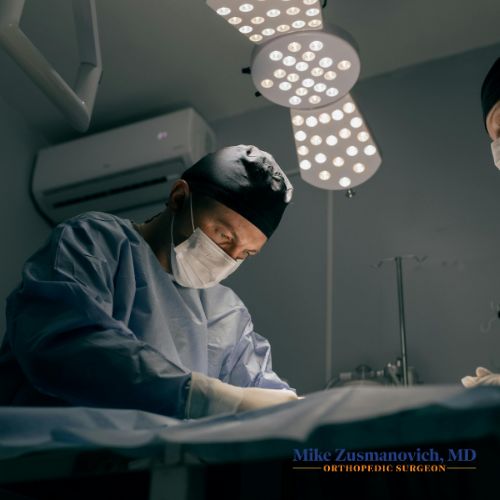
Shoulder Injury Treatment
Expert Shoulder Surgeon in Commack and Across Long Island. Dr. Mikhail Zusmanovich specializes in treating a variety of shoulder conditions to help you regain comfort and mobility.
What Does the Rotator Cuff Actually Do?
The rotator cuff is a group of four muscles and their tendons, the supraspinatus, infraspinatus, teres minor, and subscapularis, that surround the shoulder joint. Together, they stabilize the ball of your upper arm within the shoulder socket and power the full range of shoulder motion: lifting, rotating, reaching overhead, and throwing.
When one or more of these tendons tears, whether from acute injury or years of wear, the shoulder loses stability, strength, and often range of motion. Surgery repairs the torn tendon by reattaching it to the bone, allowing the tissue to heal and regain function. But “repaired” doesn’t mean “instantly restored”, and that’s where the recovery process becomes crucial.
Will You Get Full Strength Back? The Evidence-Based Answer
Research consistently shows that the majority of patients who undergo rotator cuff repair and complete a structured rehabilitation program regain strength that is equal to or very close to their pre-injury baseline. Studies report patient satisfaction rates of 85–95% following successful rotator cuff repair, with most patients returning to their previous level of work and activity.
That said, outcomes aren’t identical for everyone. Several key factors influence how much strength you recover and how quickly.
Factors That Affect How Much Strength You Recover
1. Tear Size and Severity
Tear size is one of the strongest predictors of outcome. Small to medium tears, when repaired promptly and rehabilitated properly, have excellent healing rates, and most patients recover full strength. Large or massive tears involving multiple tendons are more complex, and while surgery can dramatically improve function, full-strength recovery may take longer or be partial, depending on the extent of muscle atrophy.
2. How Long the Tear Went Untreated
This is a critical and often underappreciated factor. The longer a torn rotator cuff goes unrepaired, the more the muscle retracts and begins to degenerate, a process called fatty infiltration. Once muscle tissue converts to fatty tissue, it cannot be reversed by surgery. This is one of the most compelling reasons not to delay evaluation when shoulder pain and weakness develop.
3. Patient Age
Younger patients generally have better healing capacity and recover strength more completely. However, age alone is not disqualifying; many patients in their 60s and 70s achieve outstanding results. The key is that older patients may need a longer rehabilitation timeline and must be diligent about protecting the repair during the early healing phase.
4. Surgical Technique and Repair Quality
The repair method and the surgeon’s experience directly affect how well the tendon heals to the bone. Modern arthroscopic rotator cuff repair, which Dr. Zusmanovich performs, allows for precise, minimally invasive reattachment with less trauma to surrounding tissue, lower infection risk, and faster overall recovery compared to traditional open surgery.
5. Commitment to Physical Therapy
This may be the single most controllable factor in your recovery. Patients who consistently follow their rehabilitation protocol, without rushing or skipping phases, routinely achieve the best outcomes. Physical therapy after rotator cuff surgery is not optional. It is the difference between a repaired tendon that becomes strong and functional, and one that heals in a weakened or stiffened state.
6. Overall Health and Lifestyle Factors
Smoking significantly impairs tendon healing and is one of the most modifiable risk factors for poor outcomes. Diabetes, obesity, and certain medications can also affect tissue healing. Discussing your full health picture with Dr. Zusmanovich before surgery allows for proactive management of these variables.
What Does the Recovery Timeline Actually Look Like?
Rotator cuff recovery is measured in months, not weeks, and that’s not a bad thing. It reflects how the tendon actually heals: gradually, in stages, as new tissue forms and strengthens at the bone attachment site. Rushing this process is one of the most common causes of re-tears.
Weeks 1–6: Protection Phase
Your arm will be in a sling to protect the repair. Passive motion exercises (where a therapist moves your arm for you) begin early to prevent stiffness. Active use of the shoulder is restricted. This phase is about protecting the healing tendon, not building strength.
Weeks 6–12: Motion Recovery Phase
The sling comes off, and active-assisted exercises begin. Range of motion improves progressively. You’ll start doing more for yourself while still avoiding any significant shoulder loading. Pain levels typically improve noticeably during this phase.
Months 3–6: Strengthening Phase
Resistance training for the rotator cuff and surrounding shoulder muscles begins in earnest. Strength starts to return, often noticeably. Most patients performing desk work or light activity can return to work during this phase.
Months 6–12: Functional Return Phase
Heavy lifting, overhead work, and sport-specific activities are progressively reintroduced. For many patients, this is when they first feel “back to normal.” Full strength, objectively measured, typically returns between 9 and 12 months post-surgery for small to medium repairs.
Beyond 12 Months: Large & Massive Tears
Patients with larger tears may continue to see strength improvements beyond the 12-month mark. The tendon continues to mature and remodel for up to 2 years following repair. Patience and consistency in this latter phase pay real dividends.
What If My Tear Is Too Large to Fully Repair?
In some cases, typically massive, long-standing tears with significant muscle degeneration, a complete anatomic repair may not be possible. This doesn’t mean surgery can’t help. Options include:
- Partial repair — reattaching what tissue is viable to improve function and reduce pain
- Superior capsule reconstruction (SCR) — using a graft to restore stability when full repair isn’t feasible
- Tendon transfer — rerouting a nearby tendon to compensate for an irreparable rotator cuff
- Reverse total shoulder replacement — for patients with severe rotator cuff arthropathy (a combination of cuff tear and arthritis), this procedure can restore significant function and pain relief even when traditional repair isn’t an option.
Dr. Zusmanovich will thoroughly evaluate your imaging, symptoms, and activity goals to recommend the approach most likely to get you the best possible outcome for your specific situation.
Questions to Ask Your Shoulder Surgeon Before Surgery
Going into a consultation prepared makes a real difference. Here are the questions every rotator cuff patient should ask:
- What size is my tear, and what does that mean for my expected recovery?
- Is this a full-thickness or partial-thickness tear, and does that change the approach?
- How long have I likely had this tear, and has there been muscle degeneration?
- Am I a candidate for arthroscopic repair, or would open surgery be better in my case?
- What is my rehab timeline, and when can I return to my specific activities?
- What are the risks of waiting versus operating now?
- What is the re-tear rate for my type of repair, and what can I do to minimize it?
Talk to a Shoulder Surgeon in Commack — Get a Real Answer About Your Recovery
Fear of permanent weakness is one of the main reasons patients delay rotator cuff surgery, and that delay can make the very outcome they fear more likely. The earlier a tear is evaluated and treated, the more tissue there is to work with, and the stronger the recovery.
Dr. Mikhail Zusmanovich is a fellowship-trained shoulder surgeon serving Commack, West Babylon, and Long Island, NY. He completed his sports medicine fellowship at the Cedars-Sinai Kerlan-Jobe Institute, one of the most respected orthopedic programs in the country, and specializes in arthroscopic shoulder repair, reconstruction, and replacement.
He takes the time to review your imaging, explain exactly what he sees, and give you an honest, individualized assessment of what recovery looks like for you, not just a general statistic.
Call (631) 321-0033 or schedule a consultation online. Offices in West Babylon and multiple locations across Long Island.
Commack
🕒Hours
Mon: 9am-5pm
Tues: 9am-5pm
Wed: 9am-5pm
Thurs: 9am-5pm
Fri: 9am-5pm
Hear From Our Patients
Listen to the experiences of patients who have regained their strength and mobility after treatment with Dr. Zusmanovich.